


Ask most Indian car buyers whether they want a manual or an automatic and the answer is still the clutch pedal. Manual gearboxes account for 72 percent of used car sales in 2025, against 28 percent for automatics, according to the Gears of Growth 2025 report. It is roughly a three-to-one preference, and it has held even as automatics have become cheaper and more common in new cars.
But the single number hides the more interesting story. The report breaks transmission preference down by age, gender and region, and every one of those cuts shows the same thing: the manual majority is real, and it is also starting to erode from the edges.
Manual or automatic: what do used car buyers in India actually choose?
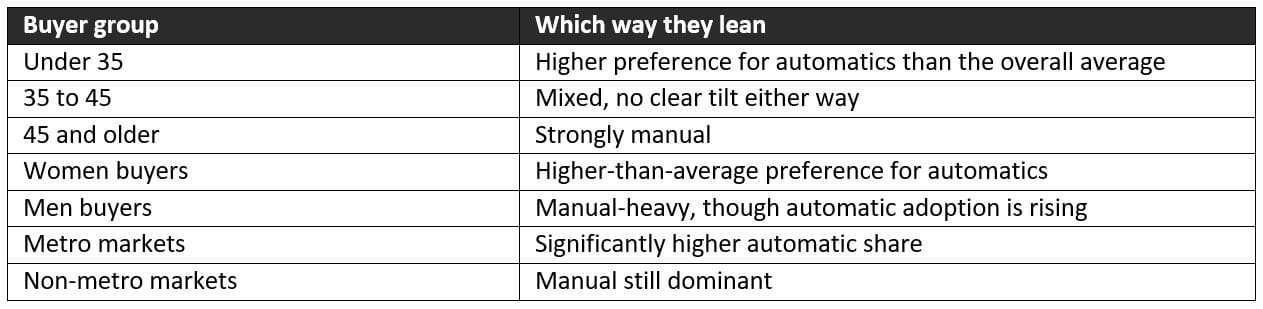
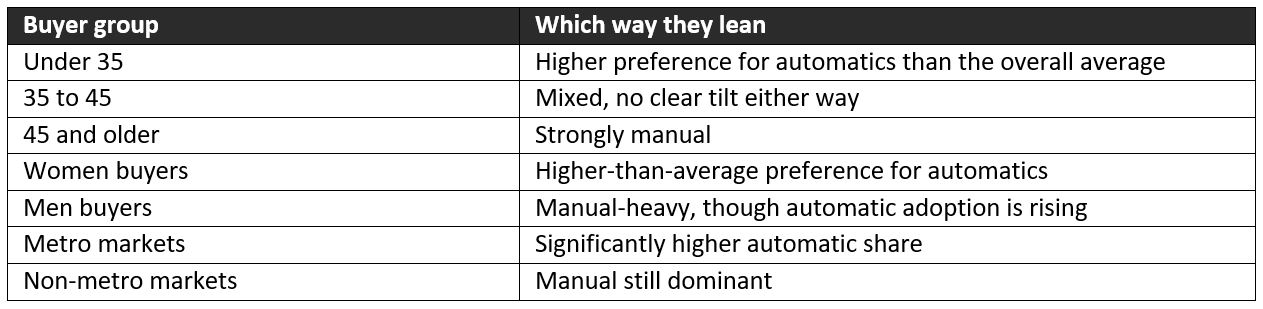
Buyers under 35 show a higher preference for automatics than the market average. Buyers over 45 stay strongly with manuals. The 35 to 45 group sits in between, with no firm tilt either way. In other words, the younger the buyer, the likelier the automatic, which tells you where the market is heading as this cohort ages into its peak earning years.
Gender pulls in the same direction. Women buyers show a higher-than-average preference for automatics. Men skew manual, though the report notes automatic adoption among male buyers is rising too. Geography completes the picture. Metro markets have a significantly higher automatic share, while non-metro India stays firmly manual.
 |
Source: Cars24 x Team BHP Gears of Growth 2025 Report
Why do most used car buyers in India still choose manual?
Three things keep the manual in front.
Cost is the first. A used manual car is usually cheaper to buy and cheaper to keep running, and it matches the value-first mindset of the non-metro markets that make up the bulk of demand.
Familiarity is the second. Most Indians learned to drive on a manual, and a first-time used car buyer tends to stick with what they can already handle.
The third is resale. A manual sells to a wider pool of buyers across more of the country, so it moves faster when the owner decides to let it go.
The report links the metro automatic tilt to the same models that lead metro demand. Models like the Maruti Baleno and the Honda City sell strongly in cities partly because buyers there accept newer model years and convenience features, automatic gearboxes among them. Outside the metros, demand concentrates on cars built to be cheap and simple, the used Swift Dzire, Wagon R, i10, Grand i10 and Alto, most of which move as manuals.
Why are used car buyers switching to automatics?
The change is being driven by how and where India drives today. The report points to traffic conditions, driving convenience and changing lifestyles as the forces pushing buyers toward automatics. Anyone who commutes daily in Bengaluru or Mumbai traffic knows the appeal of a car that does not need a clutch worked a thousand times a trip.
Younger buyers feel this most, and they are the ones entering the market in growing numbers. As the cars they bought new in the last few years cycle into the used market, automatic supply in the resale channel grows too. The 28 percent share looks more like a starting point than a settled ceiling.
Are used automatics riskier to buy than manuals?
A manual gearbox and clutch are mechanically simple and cheap to inspect and repair. An automatic, whether a torque converter, an AMT, a CVT or a dual-clutch unit, is harder to assess and costs far more to rebuild if it fails. The fear is real and specific: you buy an automatic, it drives beautifully on the test drive, and weeks later you are handed a repair bill several times what the same fault would cost on a manual. A short drive will not reveal a unit that is a few thousand kilometres from trouble.
This is exactly the fear a proper inspection and warranty are built to remove, which is why they matter more on an automatic than on a manual. Cars24’s 300-point inspection tests full transmission operation inside a process that runs over 10 hours per car, refined across more than 1 crore inspections since 2015. Every car bought comes with a 30-day repair assurance that covers the transmission with no deductible, and the transmission also sits inside the lifetime warranty cover. Bought this way, a used automatic stops being a gamble on the gearbox and becomes a car whose costliest part has been checked and is covered.
Manual or automatic: which should you actually buy?
There is no single right answer, only the right answer for how you drive. If most of your driving is stop-start city traffic, an automatic earns its slightly higher price through the daily comfort alone. If you cover long highway distances, drive mostly outside the big cities, or want the lowest running cost and the easiest resale, a manual still makes plain sense and comes with the widest choice of cars on the market.
One extra point for automatics: because the gearbox is the costly part to repair, weigh the inspection report and the warranty terms more heavily than you would on a manual. On a manual, a worn clutch is a routine, affordable fix; on an automatic, the equivalent failure is the expensive one, so ‘checked and covered’ is worth paying attention to.
Note: All figures in this article are drawn from Cars24’s own Gears of Growth 2025 report, original research based entirely on Cars24 first-party transaction data as of December 2025. Transmission preference refers to the manual or automatic split of used car transactions on the platform. No external data sources are used; the figures are proprietary to Cars24.