Exposing the Shadows: How Fraud, Waste, and Abuse Compromise Motor Third-Party Accident Claims
JAMSHEDPUR, JHARKHAND — Third-party motor accident compensation claims are designed to provide a vital financial safety net for victims of road crashes and their grieving families. However, a growing web of systemic Fraud, Waste, and Abuse (FWA) across India’s legal and insurance landscape threatens this essential protection.
From fabricated death certificates and exaggerated permanent disability scores to coordinated staged accidents, FWA in Motor Accident Claims Tribunals (MACT) inflates motor insurance premiums, drains public sector resources, and delays relief for genuine victims.
Driven by recent judicial crackdowns, including mandatory Special Investigation Teams (SITs) and digital database integrations ordered by the Supreme Court of India, insurers and law enforcement are actively reshaping the battle against motor insurance fraud.
What is FWA in Third-Party Claims?
Third-party insurance is legally mandatory under the Motor Vehicles Act. While First-Party insurance covers damage to the policyholder’s own vehicle, Third-Party coverage handles liabilities owed to external victims—paying compensation for bodily injury, permanent disability, or accidental death.
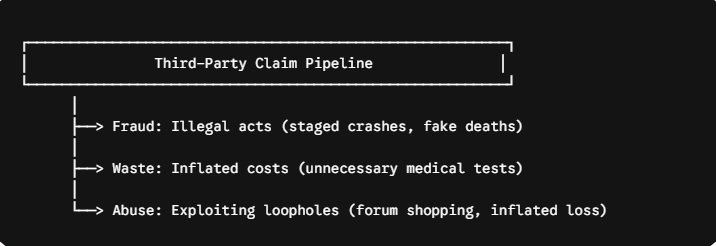
Within the motor insurance sector, FWA takes three distinct forms:
- Fraud: Intentional deception for illicit financial gain. This includes staging fake collisions, retrofitting non-road deaths into hit-and-run motor cases, or using forged disability certificates.
- Waste: Inefficient practices or systemic friction that needlessly consume capital. Examples include redundant medical examinations, excessive litigation delays, and uncoordinated administrative overhead.
- Abuse: Exploitation of legal procedures or medical frameworks without direct forgery. Examples include exaggerated pain-and-suffering assessments, misleading income declarations, or duplicate claims filed across multiple jurisdictions.
Modus Operandi: Anatomy of MACT Frauds
Investigations conducted by state Special Investigation Teams (SITs) and insurance risk-management divisions reveal how syndicates manipulate the claim adjudication pipeline:
1. Fraudulent Vehicle Implantation
When an uninsured or unidentified driver causes a fatal crash or serious injury, syndicates often “implant” a fully insured vehicle into police records after the incident. By bribing local contacts or altering First Information Reports (FIRs), non-insured collisions are recast as third-party liability claims against insurance firms.
2. Death & Injury Conversion
Natural deaths, industrial accidents, and self-inflicted injuries are frequently reformatted into road traffic accidents. Deceased individuals from natural causes have been documented as “victims” of fictitious night-time hit-and-runs, allowing syndicates to collect payouts.
3. Exaggerated & Forged Disability Certificates
Permanent partial or total disability awards rely on medical board certifications. Fraudulent schemes often involve corrupt medical practitioners issuing inflated disability assessments (e.g., certifying a minor fracture as a 70% permanent functional disability) or issuing forged certificates altogether.
4. Forum Shopping & Duplicate Claims
Claimants and unscrupulous legal representatives exploit geographical jurisdictional loopholes. The same injury or death claim is sometimes simultaneously filed before multiple MACT benches across different states or concurrently under the Employees’ Compensation Act and the Motor Vehicles Act to extract double payouts.
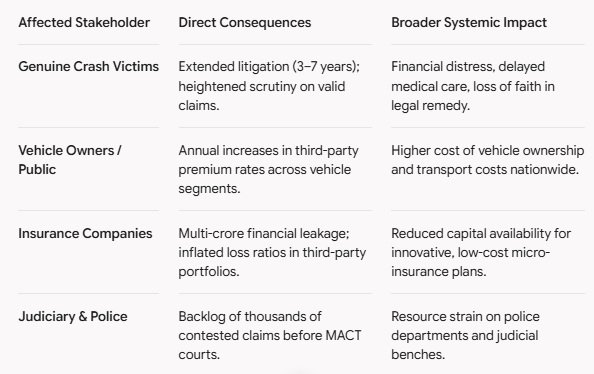
Impact Breakdown: Who Pays the Price?
FWA in third-party claims creates widespread financial and institutional harm, affecting victims, policyholders, and insurers alike:
Legal & Regulatory Response: Supreme Court Interventions
The judiciary and regulators have taken a strict stance against organized insurance fraud.
Mandatory State SITs
In landmark proceedings addressing suspicious compensation petitions, the Supreme Court of India mandated that states establish dedicated Special Investigation Teams (SITs) headed by senior police officers to investigate fake MACT claims and prosecute offending syndicates, lawyers, and medical personnel.
Digital Integration & eDAR
To dismantle paper-based forgery, the Supreme Court mandated the rollout and integration of the Electronic Detailed Accident Report (eDAR) portal.
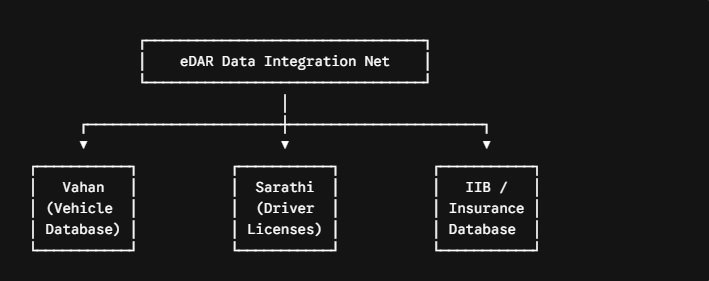
The eDAR system links road crash records directly with central databases, including:
- Vahan: Central vehicle registration network.
- Sarathi: Driving license verification system.
- Insurance Information Bureau (IIB): Live policy and claims repository.
By cross-referencing accident details, driver identities, and policy numbers automatically within 48 hours of an incident, eDAR creates an immutable digital trail that prevents vehicle implantation and duplicate filings.
Modern Detection Tools
Insurers and investigative agencies are utilizing modern technology to identify fraudulent claims before funds are disbursed:
- AI Predictive Risk Scoring: Machine learning models scan incoming MACT notices against historical fraud patterns—flagging suspicious delays in FIR filings, recurring geographic hotspots, or high-risk legal representatives.
- Biometric & Tele-Medical Verification: Medical boards and insurers now require digital Aadhaar-linked verification and standardized medical coding for disability assessments.
- Geofencing & Digital Forensics: Telematics, mobile tower records, and surveillance footage are routinely audited to verify if a suspect vehicle was present at the accident scene during the claimed timeframe.
Looking Ahead
Eliminating FWA in third-party motor accident claims requires ongoing collaboration between law enforcement, insurance carriers, medical boards, and the judiciary.
As digital integrations like the eDAR portal mature, the window for fraudulent claims continues to close. Striking out fraudulent claims ensures that compensation reaches genuine crash victims promptly, preserving the integrity of India’s road safety and social security systems.