
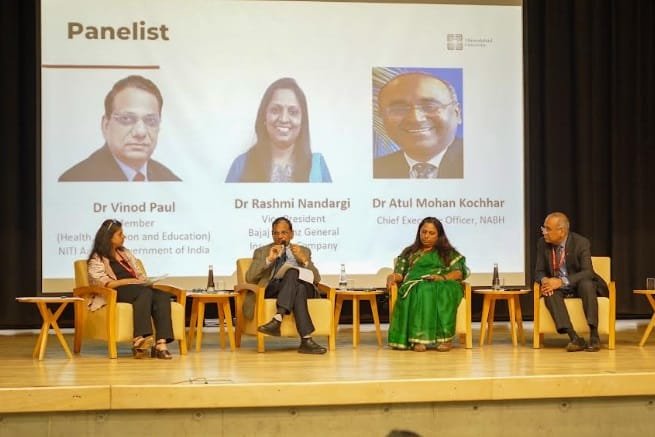


India is becoming increasingly capable at treating disease, yet the number of people who need treatment continues to grow. Chronic and lifestyle-related illnesses are appearing in larger numbers and at earlier stages of life, even as hospitals, diagnostics, insurance and digital health systems expand. This widening gap between the growth of the health economy and the health of the population set the tone for the Ahmedabad Dialogue on The Business of Health, organised by Ahmedabad University’s Bagchi School of Public Health.
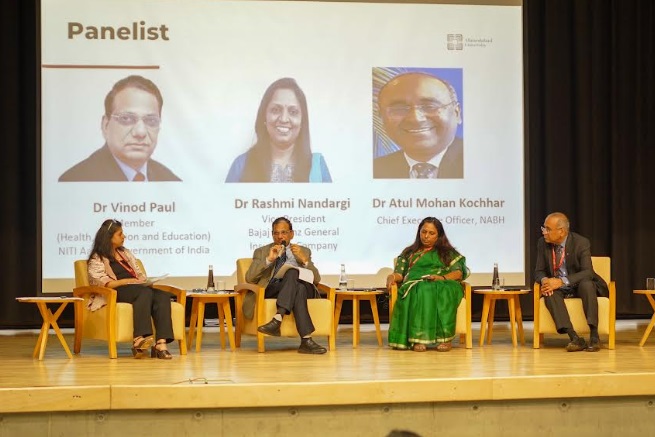 |
Panellists discuss the future of India’s health economy at the Ahmedabad Dialogue on The Business of Health at Ahmedabad University
The discussions looked closely at how growth in the health economy should be understood. The size of the sector is one lens, but another is whether the population becomes healthier over time. Policy viewpoints from Dr Vinod Paul of NITI Aayog, insurance experiences shared by Dr Rashmi Nandargi of Bajaj General Insurance and perspectives on healthcare delivery from Dr Atul Mohan Kochhar of National Accreditation Board for Hospitals and Healthcare Providers (NABH) contributed to deep deliberations on this question. What emerged is that India has the institutional strength and scientific capability to treat disease at scale, yet this does not translate into a reduction of chronic disease that are largely preventable through modification of lifestyle, environmental and commercial determinants.
A recurring theme was the structure of incentives within the system. Most financial activity begins only after illness has occurred. Hospitalisation triggers revenue. Insurance becomes relevant after health deterioration. Providers are remunerated most when procedures are complex. Prevention, in contrast, remains largely outside the core economic model. This is the result of how health systems have developed globally, and India now faces the implications as the burden of chronic disease expands.
Technology was examined through this same lens. Precision diagnostics and advanced care will continue to save lives, yet some of the most promising applications of technology lie earlier in the chain of care. Digital tools and artificial intelligence can support primary doctors, emergency responders and community health workers by providing better visibility of risk, disease prediction and earlier intervention. The shift in outcomes will come only when prevention works at a population scale.
Equity received close attention. Communities that experience disadvantage often face chronic disease earlier and with greater economic exposure. When preventive systems reach these populations in time, the gains are significant. Productive years are preserved, and the long-term social and economic cost of ill-health is reduced. Equity therefore becomes central to the sustainability of the health economy rather than an optional extension of it.
Designed as a top-tier thought leadership platform, the Ahmedabad Dialogue reflects Ahmedabad University’s liberal arts and interdisciplinary approach, where complex questions are examined from multiple perspectives rather than through a single disciplinary lens. Ahmedabad Dialogue aims to provide a setting for careful thinking on subjects that influence India’s future. The focus of this edition was on understanding how the country’s expanding health capacity can translate into healthier and longer lives.
Insights from the panel discussion and the six thematic roundtable deliberations will be consolidated and shared in the coming weeks to contribute to policy thinking across government, industry and the public health community. The aim is to support deeper reflection on how the growth of the health economy can advance the well-being of people in India.
About Ahmedabad University
Ahmedabad University is a leading private, non-profit research university offering students a liberal education focused on interdisciplinary learning, practice orientation, and research thinking.
The University has been
-
Recognised by the Government of Gujarat as a Centre of Excellence.
-
Accredited with ‘A’ grade by the National Assessment and Accreditation Council (NAAC).
-
Awarded Leadership and Management Team of the Year at the Times Higher Education Awards Asia 2025.
-
Awarded a 5-star rating, the highest awarded in the Gujarat State Institutional Rating Framework (GSIRF) for 2021-22 and 2023-24, by the Knowledge Consortium of Gujarat (KCG), Department of Education, Government of Gujarat.
-
Awarded the Royal Institute of British Architects (RIBA) International Award for Excellence 2024 for our University Centre.
-
Awarded a ‘Platinum Rating’ by the Indian Green Building Council for sustainability and green practices.
-
Recognised by the UGC under Section 12(B) of the UGC Act, becoming one of the very few private research universities to have been awarded this recognition for select research universities.
-
Recognised as a Highly Commended University for Teaching and Learning Strategy of the Year in the Times Higher Education (THE) Awards Asia 2023.
-
Awarded the AACSB’s Innovations That Inspire Award 2023 for its Foundation Programme.
-
Awarded Gold Rating by the Indian Green Building Council for achieving the Green Building Standards at our University Centre.
The University, established in 2009, is rooted in the vision of one of India’s finest educational foundations, the Ahmedabad Education Society, which was founded in 1935 by nationalist leaders. Programmes at the University range from bachelors to doctoral levels in humanities and social sciences, natural sciences, engineering, and management through its 13 Schools and Centres:
Amrut Mody School of Management | Bagchi School of Public Health | School of Arts and Sciences | School of Engineering and Applied Science | Ahmedabad Design Lab | Centre for Heritage Management | Centre for Learning Futures | Global Centre for Environment and Energy | International Centre for Space and Cosmology | Sahyog: Centre for Promoting Health | Stepwell Centre for Asian Futures | The Climate Institute | VentureStudio
An urban university, Ahmedabad promotes independent-mindedness and diversity across all dimensions of its activity and helps students mature into critical thinkers who are analytically equipped, practically oriented, and contextually aware global citizens. The University provides a contemporary educational framework that brings liberal arts, sciences, and the professions to engage together in creating new knowledge for addressing complex challenges of the society and in offering majors that merge the boundaries of disciplines to prepare students for the new economy.
